Core Beliefs: Examining The Evidence Worksheet
 GinaMarie Guarino, LMHC
Core beliefs are deeply held beliefs that a person has about oneself, the world, and the future. These beliefs are shaped by their interpretations of life experiences. Negative core beliefs can trigger negative thought patterns and can cause a person to react to upsetting situations in unhealthy ways.
A core belief can feel completely true in the moment, especially when something unpleasant happens that triggers negative thoughts. By examining the evidence of a core belief, you can build a more balanced and realistic perspective, which can support the development of healthier core beliefs.
About This Worksheet
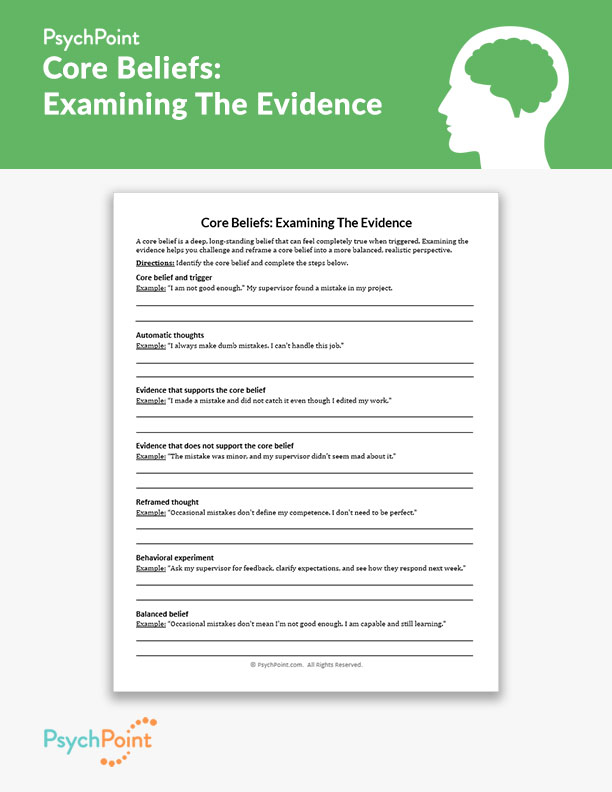
Helping clients in therapy examine evidence for negative core beliefs can reduce negative thoughts and improve their perspective. The Core Beliefs: Examining the Evidence Worksheet provides a step-by-step process of examining the evidence of negative core beliefs.
A cognitive behavioral therapy (CBT) approach is used on the Core Beliefs: Examining the Evidence worksheet to help clients develop healthier, more realistic core beliefs by examining the evidence. Adults participating in CBT can use this worksheet to learn how to examine the evidence of a negative core belief. It can be used in individual therapy.
Instructions
Introduce the Core Beliefs: Examining the Evidence worksheet, and review the introduction and each step on the worksheet with the client. Use the example provided to explain how examining the evidence challenges the validity of a negative core belief.
After reviewing each step with the client, help them identify their negative core belief and a recent trigger. Then, guide them through the exercise by completing the steps with them, leaving the final step of writing a balanced belief to be completed the following session.
Instruct the client to complete the behavioral experiment as a homework assignment to test their reframed thought. When they return for the following session, reflect on their behavioral experiment and complete the final step on the worksheet.
Help the client formulate a balanced belief to complete the worksheet. While creating a balanced belief, you may ask them reflection questions, like:
- What did you discover after completing the behavioral experiment?
- How did reframing the thought and using a behavioral experiment affect the strength of your core belief?
Review the steps for examining the evidence with the client and encourage them to use the exercise to strengthen the coping skill. Provide them with a copy of the completed worksheet for reference.
References
Beck, J. S. (2020). Cognitive behavior therapy: Basics and beyond (3rd ed.). Guilford Press.