Cognitive Restructuring: Decatastrophizing Worksheet
 GinaMarie Guarino, LMHC
Catastrophizing is a common habit that people in therapy work to overcome. It is a term that refers to a pattern of believing that the worst will happen in a challenging situation.
Catastrophizing causes people to feel a great deal of anxiety. If left unaddressed, the habit can lead to emotional reactivity that exacerbates the situation that is causing the client stress. That is why it is important to help clients learn methods for decatastrophizing. The process of decatastrophizing involves teaching clients how to challenge the assumption that the worst-case scenario will happen.
About This Worksheet
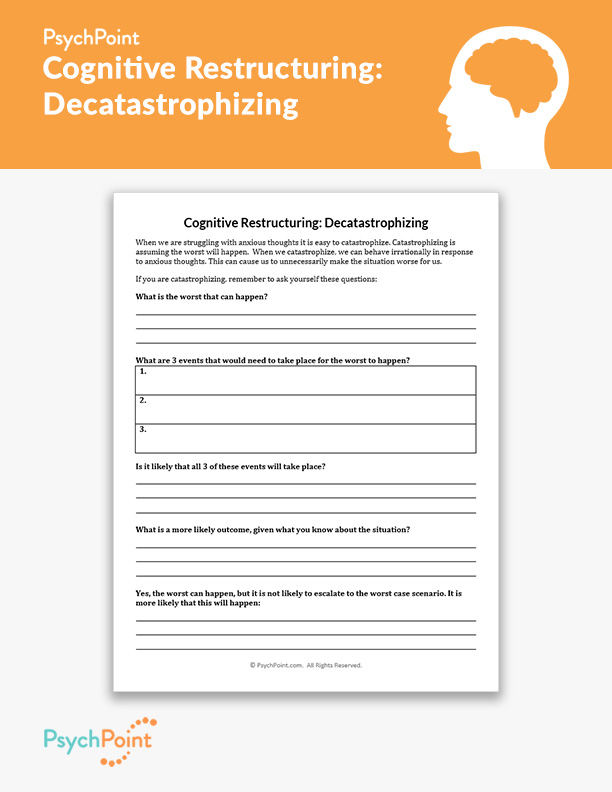
Using decatastrophizing exercises in therapy sessions can be a helpful way to encourage clients to think more mindfully. It can also aid in teaching clients how to challenge their unhealthy thought patterns. The Cognitive Restructuring: Decatastrophizing worksheet offers a process of considering other possibilities besides the worst-case scenario.
Decatastrophizing is used in cognitive behavior therapy (CBT). It helps with reducing symptoms of anxiety, depression, and more. This worksheet offers a decatastrophizing exercise to help prevent the client from jumping to conclusions. It also helps strengthen their CBT coping skills for triggering thoughts and emotions.
The Cognitive Restructuring: Decatastrophizing worksheet is a CBT exercise that can be used in individual and group therapy sessions. It is intended for adolescents and adults.
Instructions
Before presenting the Cognitive Restructuring: Decatastrophizing worksheet to your client, provide a brief explanation of what catastrophizing is and how it affects how they feel. Then, explain how using decatastrophizing skills to challenge anxious thoughts can help reduce anxiety.
Review the introduction on the worksheet with the client and answer any questions they have. Then, instruct them to recall a recent catastrophized thought and answer the questions provided on the worksheet.
Reflect on the responses to the reflection questions with your client. Start a dialog about how it felt to use the decatastrophizing process on this worksheet. You may ask reflection questions, like:
- How intense is the catastrophized thought after completing this worksheet?
- What are your biggest triggers for catastrophizing?
- How can we help you build a habit of using this decatastrophizing process when you feel triggered?
Instruct the client to refer to this worksheet the next time they feel themselves getting anxious because of their catastrophizing thoughts. Encourage them to practice the process of decatastrophizing to promote the use of healthier coping skills.
References
Beck, J. S. (2020). Cognitive Behavior Therapy, Third Edition: Basics and Beyond. New York, NY, USA: Guilford Press.
Download
Download Cognitive Restructuring: Decatastrophizing Worksheet