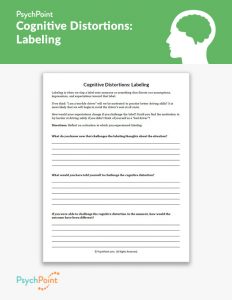
Cognitive Distortions: The "Shoulds" Worksheet
 GinaMarie Guarino, LMHC
Cognitive distortions, or thinking errors, are common patterns of thinking that can influence a client's mental health. They are habitual ways of interpreting situations in ways that are often inaccurate or unhelpful. Cognitive distortions can reinforce negative thoughts, trigger strong emotional reactions, and lead to unhelpful behaviors.
Teaching clients ways to recognize and challenge cognitive distortions is a key part of helping them feel better and make healthier choices. Cognitive distortions can make it difficult to see challenging situations clearly or respond in helpful ways. That is why it is important to understand how distortions, such as 'should' statements, can affect a person's ability to cope with stress and manage emotions effectively.
About This Worksheet
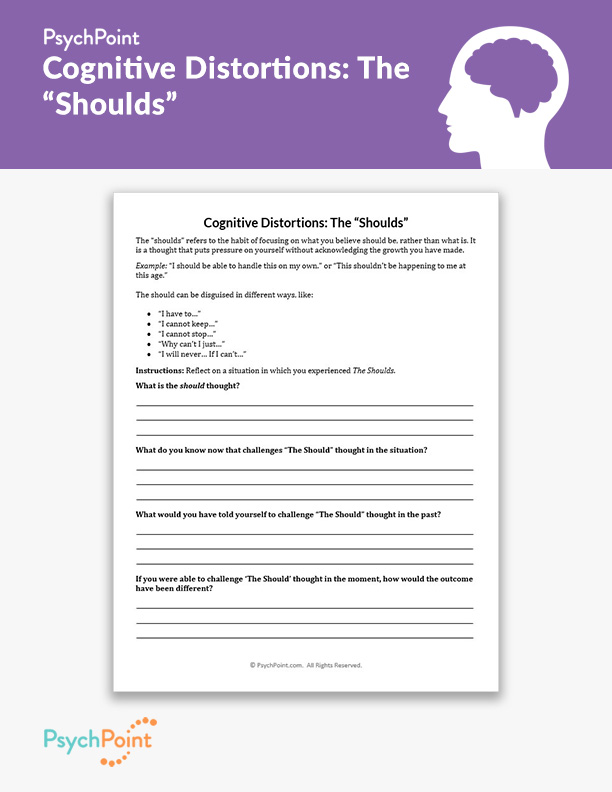
Teaching clients about how cognitive distortions like 'the shoulds' may be affecting them can help encourage healthier thought patterns. The Cognitive Distortions: The Shoulds worksheet provides a brief explanation of what 'the shoulds' are, with an example of how people experience them.
The Cognitive Distortions: The Shoulds worksheet is a tool for clients to learn about what 'the shoulds' are and how they affect thinking, feelings, and behavior. It is ideal for adolescents and adults participating in cognitive behavioral therapy.
Instructions
Review the introduction and examples of 'the shoulds' with your client. After reviewing the introduction and example with the client, instruct them to complete the reflection questions.
When the client is ready, review their responses with them and discuss how modifying thought patterns affected by 'the shoulds' can help them learn healthier thought patterns. You may ask reflection questions like:
- What 'should' thought do you tell yourself often?
- How do 'should' thoughts make you feel when you have them?
- How can you reframe a 'should' thought so it does not have such an effect on you?
Use the client's completed worksheet to help them practice reducing the habit of thinking in the 'shoulds.' Encourage them to refer to it whenever they notice these 'should' thoughts between sessions.
References
Beck, J. S. (2020). Cognitive Behavior Therapy, Third Edition: Basics and Beyond. New York, NY, USA: Guilford Press.