Thought Log Worksheet
 GinaMarie Guarino, LMHC
Ruminating or negative thoughts are a common struggle for clients in therapy. Having difficulty controlling overwhelming thoughts can be frustrating for a client, as it contributes to ongoing challenges with anxiety, depression, and more. Ruminating thoughts are distracting and prevent clients from feeling comfortable and secure in their daily lives.
If a client struggles with negative thoughts, they need to learn skills to manage them in a healthy way. Managing ruminating or negative thoughts will help them learn how to manage stress, anxiety, and negative self-talk. It will also help them feel more in control of their mental wellness.
About This Worksheet
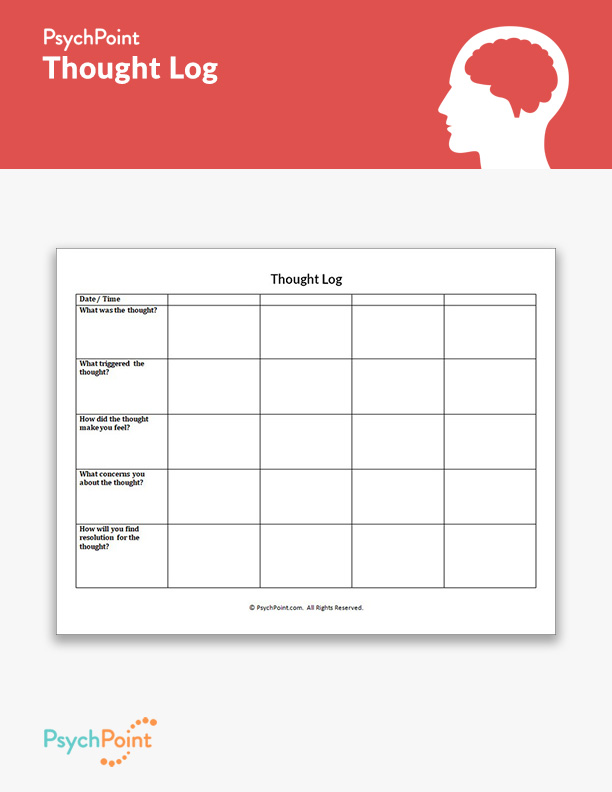
Thought logs can help clients organize their thoughts and learn how to apply thought-challenging skills. Thought-challenging skills can promote gentle self-talk and teach clients to resolve their discomfort. The Thought Log worksheet uses concepts from cognitive behavioral therapy (CBT) to help clients process their thoughts in the moment. This can help build healthier thought patterns and resolve internal conflict.
The Thought Log worksheet is designed as homework, but it can also be used during therapy sessions to help clients process uncomfortable or conflicting thoughts. It can be used with adolescents and adults in individual or group therapy.
Instructions
Educate the client on the importance of learning to challenge negative or ruminating thoughts and how such skills can help reduce stress and improve mental health. Review the worksheet with the client before assigning it to them as homework.
On this worksheet, the client is asked to record the date and time of a ruminating thought that is affecting them. Then, they are asked 5 follow-up questions. These questions are intended to help the client process their thought and understand how it is affecting them.
Complete at least 1 column with the client during the therapy session as an introduction to the exercise. When the column is completed, talk with the client about how the process has aided in modifying their thought patterns. You may ask them reflection questions, like:
- What changes do you notice in how you feel about the thought?
- How is this process different than how you usually cope with overwhelming thoughts?
- What kinds of situations do you think this exercise can help with?
Use the worksheet as a guide for processing thoughts in session or assign it to the client as a homework assignment. Referencing this worksheet while the client learns how to process their thoughts can aid in building the skill.
References
Beck, J. S. (2020). Cognitive Behavior Therapy, Third Edition: Basics and Beyond. New York, NY, USA: Guilford Press.