Self-Care Assessment Worksheet
 GinaMarie Guarino, LMHC
Practicing effective self-care is an important part of mental health. Without self-care, people cannot grow and learn how to cope with the stress of their daily lives. It is particularly important to practice self-care when struggling with your mental health. Self-care helps promote skills to maintain healthy coping and mental wellness.
Self-care is important, but it can be easy to fall out of a self-care routine when struggling with stress or mental illness. A great way to begin a conversation about self-care is to educate the client on its importance and introduce a self-care assessment in therapy.
About This Worksheet
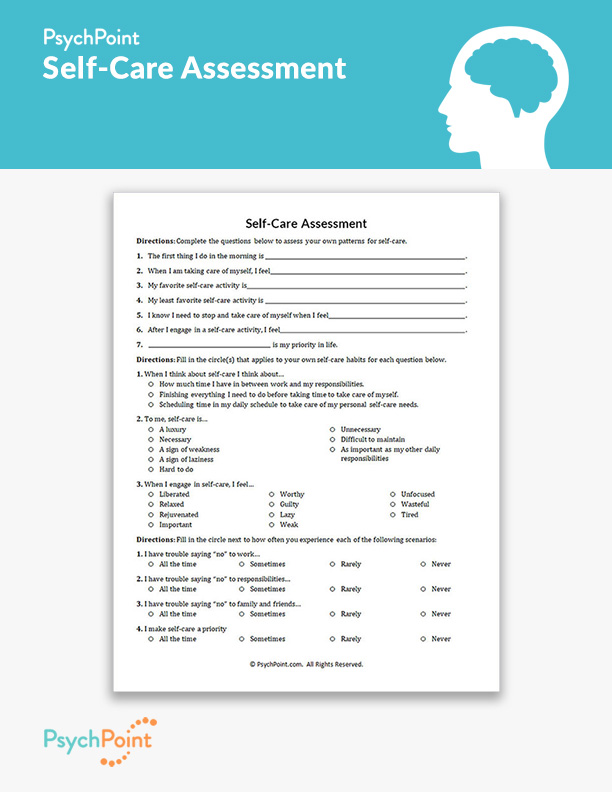
The Self-Care Assessment worksheet is a tool to use in session when assessing a client's understanding of what self-care means and their motivation to incorporate it into their lives. It can help clients identify the self-care practices that work best for them and their motivation to prioritize taking care of their personal needs.
This worksheet provides three sets of self-care questions for the client to answer. It serves as a guide for explaining the importance of self-care and the skills needed to begin incorporating self-care into their daily routine.
The Self-Care Assessment worksheet can be a great tool for adults in individual, group, or family counseling. It can be helpful for people who are struggling with anxiety, depression, and stress at work, school, or home. It can also be helpful for those struggling with self-esteem and relationship issues.
Instructions
The Self-Care Assessment worksheet consists of self-care questions divided into three sections. Each section is designed to help the client learn about prioritizing self-care. Explain why self-care can help the client feel better and manage their day-to- day stressors. Then, instruct them to complete the questions provided on the worksheet.
Once the worksheet is complete, review the results with the client. Reflect on the client's intentions for promoting self-care by asking questions, like:
- What is your motivation to boost your self-care?
- How can prioritizing self-care help you improve your lifestyle?
- What self-care habits do you want to incorporate into your daily routine?
- What steps can we take to help you prioritize your self-care habits?
Develop a plan of action to incorporate self-care skills into the client's daily routine. Provide them with a copy of the worksheet for reference.
References
Martínez, N., Connelly, C. D., Pérez, A., & Calero, P. (2021). Self-care: A concept analysis. International journal of nursing sciences, 8(4), 418–425. https://doi.org/10.1016/j.ijnss.2021.08.007
Pilkington, K., & Wieland, L. S. (2020). Self-care for anxiety and depression: a comparison of evidence from Cochrane reviews and practice to inform decision-making and priority-setting. BMC complementary medicine and therapies, 20(1), 247.