Worry Coping Skills For Kids Worksheet
 GinaMarie Guarino, LMHC
Worrying is a natural feeling, and coping with worries can be uncomfortable without healthy coping skills. A child in therapy may struggle with anxiety or moments of uncertainty, so teaching them healthy ways to cope and express themselves can be instrumental in their treatment.
Kids may express their worry in ways that adults may not pick up on quickly. Some kids act out while others shut down, so it can be hard for a child to get the attention they need when they are feeling worried. Teaching self-soothing and healthy communication skills can help build confidence in managing worries and in reaching out for support when needed.
About This Worksheet
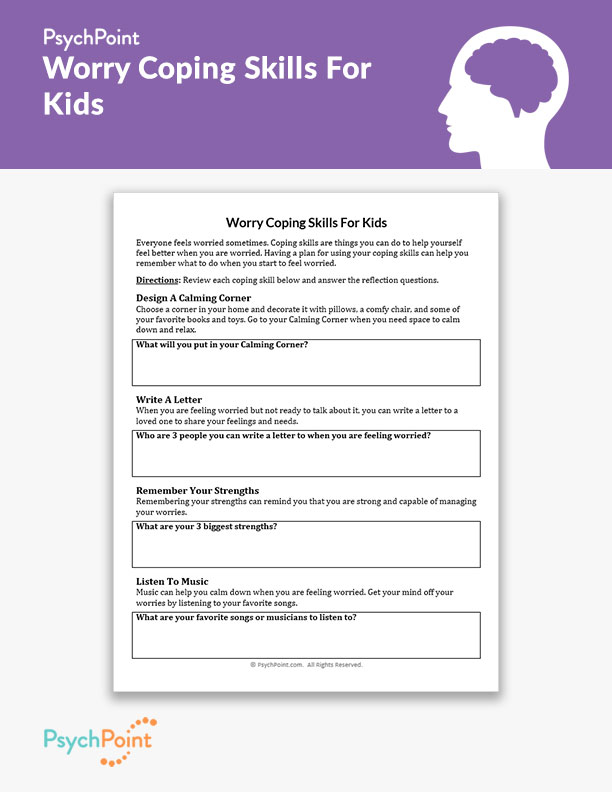
Giving kids and their parents coping skills to use at home can help promote a healthy and safe environment for managing anxiety and worries. The Worry Coping Skills For Kids worksheet provides 4 healthy coping skills for kids to use when they are feeling worried.
Children aged 5 and older can benefit from using the Worry Coping Skills For Kids worksheet. It can be utilized in individual or family sessions, as long as the parents participate in learning how to encourage using the coping skills at home.
Instructions
Introduce the worksheet to the child and review the coping skills. If available, have the parents present while you teach the child how to use each coping skill. Allow the child time to answer the reflection questions as you review each coping skill on the worksheet.
Before the end of the session, develop a plan with the child and parents for when and how to use each coping skill. During the next session, check in with the child on how they did with using their worry coping skills. Ask them questions, like:
- Which skill did you find most helpful?
- Are there any coping skills that you struggled with?
Use the discussion to encourage continued use of the worry coping skills. Check in with the parents to ensure that they are properly encouraging the worry coping skills at home.
References
Brasfield, M., Elswick, S., Raines, S., Peterson, C., & Mboge, S. (2024). Classroom calming corners: Peaceful spaces for times of transition. International Journal of the Whole Child, 9(1), 1–10.
Murray, J., & Tostevin, L. (2023). Improving emotion regulation and communication for children: A pre-post trial of a school-based approach. Mental Health & Prevention, 30, Article 200282.
Thoma, M. V., La Marca, R., Brönnimann, R., Finkel, L., Ehlert, U., & Nater, U. M. (2013). The effect of music on the human stress response. PLOS ONE, 8(8), e70156.
Toback, R. L., Graham-Bermann, S. A., & Patel, P. D. (2016). Outcomes of a character strengths–based intervention on self-esteem and self-efficacy of psychiatrically hospitalized youths. Psychiatric Services, 67(5), 574–577.