"I" Statements For Kids Worksheet
 GinaMarie Guarino, LMHC
Teaching kids in therapy how to talk about their feelings and needs is an important part of their mental health care. Children often have feelings and needs they may not know how to express. This struggle can cause confusion and frustration for both children and their caretakers, which is why encouraging healthy communication skills is important.
Learning to express their feelings and needs can help children build confidence in self-advocacy. It also helps promote healthy self-esteem and build emotional intelligence and coping skills. Teaching kids how to express themselves can also reduce behavioral issues that may stem from unmet emotional needs.
About This Worksheet
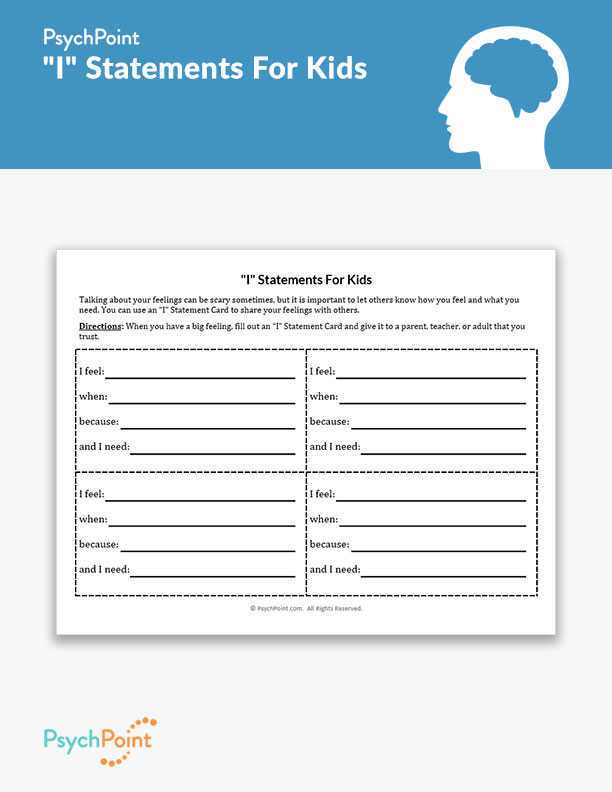
Children who learn how to express their feelings and needs will feel more confident when self-advocating, setting boundaries, and verbalizing when something does not feel comfortable or safe. Teaching kids how to use “I” statements can help them build self-esteem and reduce behavioral issues rooted in unmet needs and unacknowledged feelings. The “I” Statements For Kids worksheet provides a simple prompt for kids to use when needing to talk about their feelings and needs.
The “I” Statements For Kids worksheet is a tool for therapists and school counselors to use with kids who are learning ways to communicate. It is a sentence completion exercise that can help children in individual, group, and family therapy.
Instructions
Four “I” Statement Cards are provided on this worksheet. Introduce the “I” Statements For Kids worksheet to kids who are struggling to communicate their feelings. Review the introduction and directions with the client and explain how to use the cards to make “I” Statements.
When you are confident that the client understands how to complete the “I” Statement card, cut out the four cards and give them to the client. Instruct them to fill out an “I” Statement card and to give it to a trusted adult when they need help communicating a big feeling or need.
When the client returns for their next session, check in on how they used their “I” Statement cards. Ask discussion questions, like:
- How did it feel to write your “I” Statement cards and give them to someone you trust?
- What happened after you gave them the card?
- How do you feel about reading your card aloud next time?
Continue to use the “I” Statement cards as practice for building communication skills, providing the client with new cards as needed. Encourage the client to begin reading the cards aloud when they’re ready. Reinforce the use of “I” Statements to build healthy communication and self-advocation skills.
References
Caldarella, P., Christensen, L., Kramer, T. J., & Kronmiller, K. (2009). Promoting social and emotional learning in second grade students: A study of the Strong Start curriculum. Early Childhood Education Journal, 37(1), 51–56.
Chen, J. J., Liang, X., & Lin, J. C. (2024). Weaving the fabric of social and emotional learning in the context of teaching: A study in Hong Kong kindergarten classrooms. Early Childhood Education Journal, 53(5), 1521–1536.